Yes, Japan has tattoo schools: private, paid courses run by tattoo studios and organizations, lasting anywhere from a two-hour trial to a one-year program. There is no government license for tattoo artists in Japan, so a school's certificate or "grade" is the school's own, not a legal qualification. Below we compare three schools using the prices on their own websites (checked October 25, 2026), note one more school we could not confirm, explain how school differs from a studio apprenticeship, and cover the legal and hygiene basics.
Key takeaways
- Tattoo schools in Japan are private courses, from a 2-hour trial (¥38,500) to a one-year program (from ¥1.58 million)
- Longer courses at the three schools we checked cost ¥158,000 to about ¥555,000
- No license is needed to tattoo in Japan. A 2020 Supreme Court decision held that tattooing by a non-doctor is not a medical act
- No law sets hygiene rules for tattooing; artists learn them from guidelines such as the one published by the Japan Tattooist Association
- An apprenticeship means training to work at that studio. Some pay apprentices; some charge a monthly fee
- Browse tattoo artists in Japan
Before choosing a school or a studio, decide which style you want to learn. You can browse tattoo artists and tattoo studios across Japan on Tattoo Japan and see their work.
Do You Need a License to Tattoo in Japan?
No. On September 16, 2020, Japan's Supreme Court ruled that tattooing by a tattoo artist who is not a doctor is not a "medical act" under the Medical Practitioners' Act, so no medical license is required. (Source: Supreme Court of Japan, Case No. 2018 (A) 1790 (Japanese))
The decision said the health risks of tattooing have to be prevented by means other than reserving it for doctors. A concurring opinion added that any regulation should come through new legislation, and that tattooing can still amount to the crime of injury depending on how it is done. (Source: full text of the decision, PDF (Japanese))
That leaves certificates from schools and private bodies as just that: private. JTAG, which runs a tattoo skills exam, describes its own exam as a private certification, says it is not a tattoo artist certification, and notes that you can work as a tattoo artist without it. (Source: JTAG (Japanese))
One exception matters if you come from the beauty industry: permanent makeup such as eyebrows and eyeliner (called art make in Japan) is treated as a medical act. Japan's Ministry of Health, Labour and Welfare says a non-doctor who does it as a business violates the Medical Practitioners' Act. (Source: MHLW (Japanese))
Tattoo Schools in Japan: Courses and Costs
These are the three schools whose current courses and prices we could confirm on their official sites (as of October 25, 2026). They are listed in no order of preference, and INK TOKYO, whose site is under maintenance, follows them without prices. Prices are as each school shows them; not every school says whether tax is included. All three publish their course details in Japanese.
| School / course | Price (as listed) | Length |
|---|---|---|
| NTA Grade 3 (intro) | ¥49,800 | 2 lessons, 1 month |
| NTA Grade 2 | ¥158,000 | 1 month |
| NTA online | ¥29,800 a month | 60 min a month |
| Ray's 3 hours | ¥180,000 (tax incl.) | 3 hours, one-on-one |
| Ray's 7 hours | ¥330,000 (tax incl.) | 7 hours, one-on-one |
| Nagoya trial | ¥38,500 | 2 hours |
| Nagoya Master | ¥225,000 | 6 hours × 2 days |
| Nagoya Business | ¥550,000* | 6 hours × 2 days |
*Tattoo School Nagoya lists its Business course at ¥550,000 on the course page and ¥555,000 on its home page. NTA's own pages also give different lesson counts for Grade 2. Confirm both with the school before you sign up.
Equipment changes the total. Tattoo School Nagoya's Master course includes a tattoo kit, while Ray's sells a practice set as an add-on to its tuition.
Nippon Tattoo Academy (NTA)
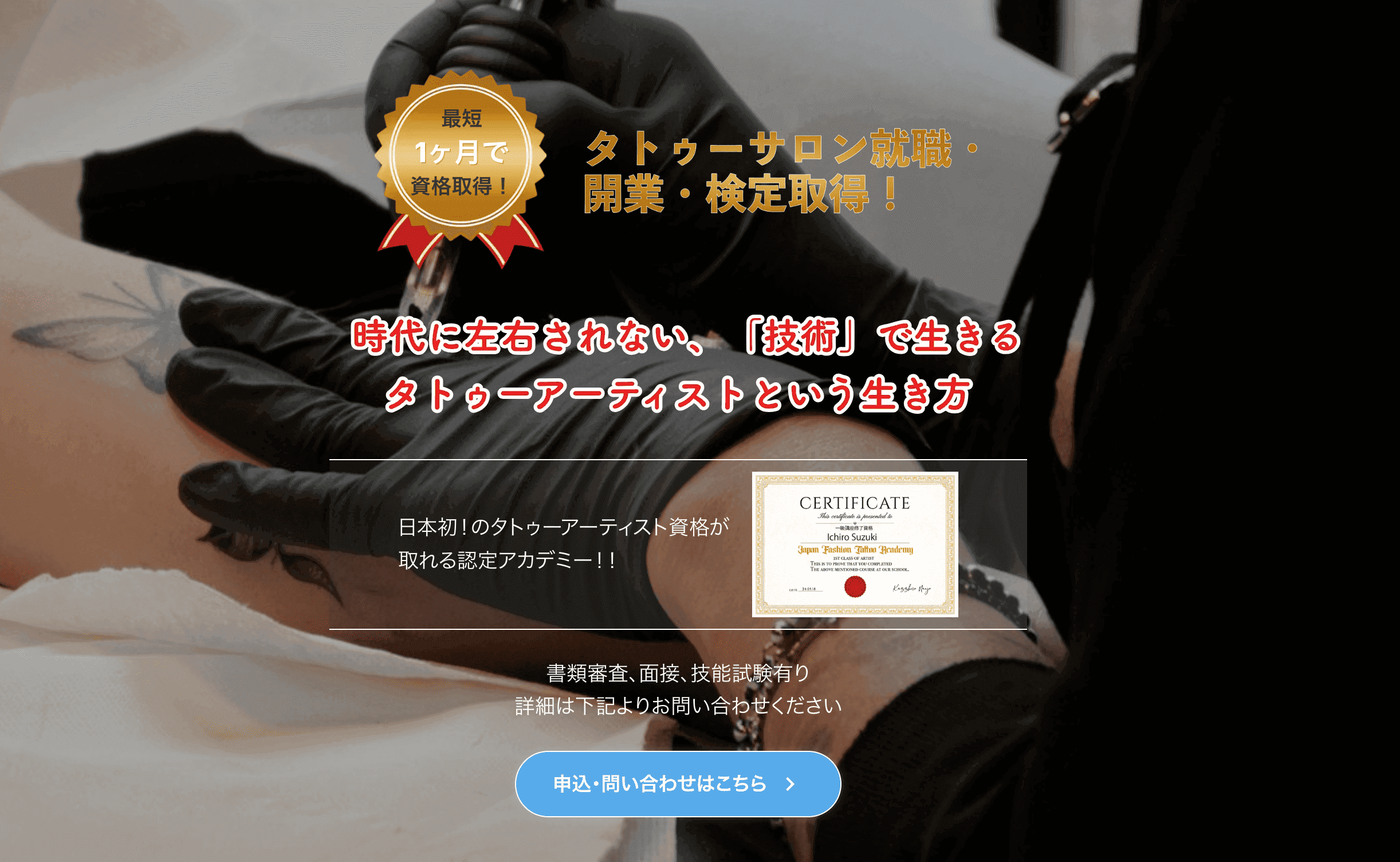
Run by the Nippon Tattoo Academy (日本タトゥーアカデミー), a general incorporated association in Meguro, Tokyo, which says it teaches at three bases: Tokyo, Osaka and Okinawa. Classes have up to eight students.
- Grade 3 (intro): legal interpretation, hygiene, how to use the tools, basics
- Grade 2: choosing needles and ink; lining, shading and coloring
- Grade 1: only for Grade 2 holders; 20 lessons including tattooing models and aftercare. No price is listed, and the school says passing is not guaranteed
- Also: a monthly online course (¥29,800, 60 minutes a month) and a one-year program for opening your own studio that includes an instructor qualification (from ¥1,580,000, with document screening)
NTA says it accepts lump-sum payment, installments, Japan's government education loan and credit cards. (Source: NTA school site (Japanese); NTA corporate site (Japanese))
TATTOO STUDIO Ray's Tattoo School
A school run by a tattoo studio with shops in Kyoto (Fushimi) and Tokyo (Meguro). The owner, Daniel Ray Brewster, teaches every lesson one-on-one.
- Three course lengths: 3, 5 and 7 hours, at ¥180,000, ¥260,000 and ¥330,000 for tuition only (tax included)
- Students taking 7 hours or more can extend at ¥30,000 an hour (up to 2 hours)
- Topics include tattoo supplies, hygiene, needle basics, machine work and design in Procreate
- Practice is on silicone skin only, and the school asks students not to tattoo people after the course
- Minimum age 19 (no high school students); full payment in advance
Cancellation costs 50% of the fee from one month to one week before the lesson, and 100% after that. (Source: TATTOO STUDIO Ray's, tattoo school (Japanese))
Tattoo School Nagoya
Tattoo School Nagoya (名古屋タトゥースクール) is in Osu, Nagoya. Its instructor is described as a working tattoo artist with more than 20 years in the trade.
- Trial: ¥38,500 for 2 hours, tattooing artificial skin
- Master: ¥225,000 including a kit; 6 hours × 2 days; up to 4 students. Basics, applied work, practice on artificial skin, Q&A
- Business (one-on-one): 6 hours × 2 days, adding how to set up a studio, plus consent-form templates
- Single-topic sessions (lining, solid fill, color and more): ¥44,000 for 3 hours (custom topic ¥49,500)
Students must be 18 or older; the course pages say students in school are not accepted. Payment is in full with no installments, and the booking deposit (¥10,000 for one-day courses, ¥20,000 for two-day courses) is not refunded if you cancel or change the date. (Source: Tattoo School Nagoya (Japanese); Master course page (Japanese))
INK TOKYO (Website Under Maintenance)
INK TOKYO is a tattoo school listed in earlier versions of this article. Its official site has shown a maintenance page since October 18, 2026, and it was still unavailable (HTTP 503) when we checked again on October 25, 2026. We could not confirm its current courses or fees, so we list no prices. If you are considering it, check the official site once it reopens. (Source: INK TOKYO official site)
Tattoo School vs Apprenticeship in Japan
The other way in is an apprenticeship at a studio. The key difference: an apprenticeship trains you to work at that studio.
| Tattoo school | Apprenticeship | |
|---|---|---|
| Where | Course or teacher's studio | The studio you join |
| Money | You pay tuition | Paid, or a monthly fee |
| Length | Set by the course | Depends on your progress |
| Practice | Mostly artificial skin | Assignments, models |
| Afterward | No job guarantee | You work at the studio |
The apprenticeship column is based on the two studios below.
STROKER TATTOO in Yokohama writes in its apprentice recruitment notes that training on a salary is different from a school, and that it is not looking for people who want to learn and then go independent. (Source: STROKER TATTOO, notes for apprentice applicants, Jan 2023 (Japanese))
Other apprenticeships charge a fee. At TATTOO STUDIO Ray's KYOTO, apprentices pay ¥50,000 a month (instruction and use of the facilities) and work through set assignments. Applicants must be 20 or older and able to work at the Kyoto studio after their debut, on an independent-contractor basis, with a route to full-time employment (conditions apply). (Source: TATTOO STUDIO Ray's, apprentice recruitment (Japanese))
Learning Irezumi and Tebori
None of the three schools above lists a course in tebori, the Japanese technique of tattooing by hand. CNN's 2019 profile of the tebori artist Ryugen describes the traditional route: his career began with a lengthy apprenticeship. After shadowing his master for a year he turned professional, but it took another seven years of study before he felt ready to open his own studio. (Source: CNN, January 2019)
For the difference between irezumi, tebori and machine work, see our guide to irezumi vs tattoo, or browse Japanese traditional designs.
Hygiene Training for Tattoo Artists in Japan
No law sets hygiene rules for tattooing either. A research team funded by Japan's Ministry of Health, Labour and Welfare (fiscal 2022) noted that after the 2020 decision, no safety law applies to tattooing by non-doctors. With the Japan Tattooist Association's cooperation, the team drafted a hygiene guideline for tattoo studios, which it said all tattoo artists and studios are expected to follow. (Source: MHLW research database (Japanese))
The Japan Tattooist Association (日本タトゥーイスト協会), an industry body, publishes its own guideline with the same Japanese title (2026 edition) for anyone to read. It covers the studio and equipment, handling of tools, infection control, disinfection and cleaning, and tells artists to treat all blood and body fluids as if they carry HIV, hepatitis B or C or other bloodborne pathogens. (Source: Japan Tattooist Association hygiene guideline (Japanese); hygiene resources (Japanese))
The association recommends that new artists read the guideline and complete its online hygiene course before opening for business. The course is for members; full membership (artists, apprentices, studio owners) costs ¥10,000 a year. (Source: About the association (Japanese); Membership (Japanese))
Questions to Ask Before You Enroll
Before you sign up, ask:
- Total cost: tuition, equipment, certificate fees, and whether tax is included
- Hands-on time: how many hours you actually tattoo
- Practice surface: artificial skin only, or real skin as well
- Hygiene: is there a hygiene and law module, and how much does it cover
- Instructor: who teaches, and what their own work looks like
- Payment: installments, cancellation fees, deposits
- Eligibility: minimum age (18 or 19 at the schools above)
- Afterward: is a studio placement promised, or only suggested
- Language: the course pages are in Japanese, so ask how lessons are taught
The best guide to an instructor is their portfolio. Look at Japanese traditional or black and grey work, then find artists who specialize in the style you want to learn.
Frequently Asked Questions
How much does tattoo school cost in Japan?
At the three schools we checked, trial and intro courses cost ¥38,500–¥49,800, and longer courses ¥158,000 to over ¥550,000. NTA's one-year program for opening a studio starts at ¥1,580,000. Equipment and certificates can cost extra.
How long does it take?
Courses range from a 2-hour trial to a one-year program. Finishing a course doesn't guarantee work: NTA, for example, states that passing its top grade is not guaranteed, so ask what support comes after.
Is tattooing legal in Japan?
No license is required: the 2020 Supreme Court ruling held that tattooing by a non-doctor is not a medical act. A concurring opinion notes that tattooing can still amount to the crime of injury depending on how it is done. Permanent makeup of eyebrows or eyeliner (art make) is the exception: it is still treated as a medical act.
What is the minimum age?
It depends on the school. Tattoo School Nagoya takes students from 18, and TATTOO STUDIO Ray's from 19 (no high school students). NTA's website doesn't state an age requirement.
Are there tattoo schools in Osaka or Fukuoka?
NTA has a base in Osaka, and TATTOO STUDIO Ray's runs its school in Kyoto as well as Tokyo. We couldn't confirm a tattoo school based in Fukuoka as of October 25, 2026. Tattoo Japan lists 19 tattoo studios in Fukuoka Prefecture, so another route is to browse studios in Fukuoka and ask whether they take apprentices.
Can I learn tattooing online?
NTA offers a monthly online course of 60 minutes for ¥29,800, aimed at busy people and those outside the big cities who want to study at home and ask questions. Ask how much hands-on instruction it includes before you sign up.
The Bottom Line
Tattoo schools in Japan are private courses that you pay for. Price, hours, real-skin practice and hygiene teaching all differ, so compare what each school publishes. No license is required, and hygiene standards come from industry guidelines rather than law.
Before you choose between a school and an apprenticeship, look at the work of artists in the style you want to learn.
This article is based on the schools' and organizations' official websites and Tattoo Japan's listings as of October 25, 2026. Courses and prices change, so check with each school before you apply.