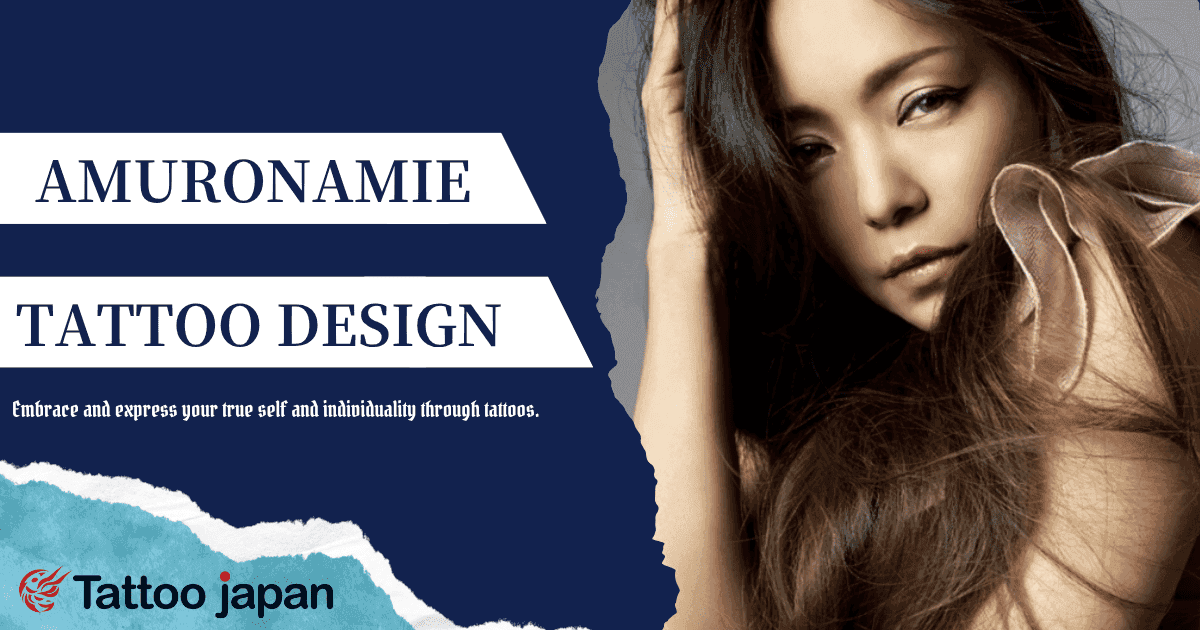
J-pop singer Namie Amuro (安室奈美恵), who retired in 2018, was known for two tattoos on her left upper arm: her son's name, HARUTO, under an oval of English text. Near her right wrist she had a barcode and a clover-like design. She never announced that she had them removed. Reports from Japan only say they looked faded or were often not visible. Here is what each tattoo shows, what was actually reported, and the sources.
Key points
- Left upper arm: "HARUTO", her son's name, under an oval of English text. Japanese media reported that she got it in early 2002 and first showed it in public that August
- The English text includes "R.I.P" and is said to be a message to her late mother. She never explained it herself
- Near her right wrist: a clover-like design and a barcode. The popular claim that the barcode encodes her birthday has no reliable source
- Neither she nor her agency ever said she removed them. They were often not visible on TV or at concerts, which is where the rumors come from
Thinking about a name or a dedication? Browse lettering tattoo designs and upper arm tattoo designs on Tattoo Japan.
Who Is Namie Amuro?

- Name
- Namie Amuro (安室奈美恵). In Japanese name order: Amuro Namie. It is also her real name
- Born
- September 20, 1977
- Hometown
- Naha, Okinawa
- Debut
- 1992, as a member of the group Super Monkey's
- Labels
- Eastworld (1992–1995), Avex Trax (1995–2013), Dimension Point (2013–2018)
- Retired
- September 16, 2018
Namie Amuro is a retired singer from Naha, Okinawa. She debuted in 1992 with the group Super Monkey's and went solo after the 1995 hit "Try Me (Watashi o Shinjite)". In 1996 she became the youngest artist ever to win the Japan Record Award, and she won it again in 1997. (Source: Sankei Sports, September 21, 2017, archived (Japanese))
Her hits include "Can You Celebrate?" (1997), and her look started a fashion craze: young women who copied her style were nicknamed "Amura" (アムラー). Around the time of her single "Respect the Power of Love", a "tattoo bracelet" accessory also became a trend. (Sources: Wikipedia; J-CAST, September 29, 2017 (Japanese))
She announced her retirement on her 40th birthday, September 20, 2017, and retired on September 16, 2018. (Source: The Star / The Yomiuri Shimbun, September 22, 2017)
Namie Amuro's Tattoos at a Glance
These are the tattoos you can see in photos or that Japanese media reported:
| Placement | Design | Reported meaning |
|---|---|---|
| Left upper arm | English text with "R.I.P" | Said to honor her late mother |
| Left upper arm | HARUTO | Her son's name |
| Near right wrist | Clover-like design | Unknown |
| Near right wrist | Barcode | Her birthday (unconfirmed) |
We found no interview in which Amuro explained any of these tattoos. Below, we separate what reports and photos confirm from what is only repeated online.
Left Upper Arm: A Message for Her Mother

High on her left upper arm, close to the shoulder, is an oval filled with English text. In photos you can make out "R.I.P" (rest in peace).
A 2017 article in the Japanese daily Nikkan Gendai quotes an entertainment writer who says the tattoo is reportedly made up of her son's name and a message to her late mother. (Source: Nikkan Gendai, September 22, 2017 (Japanese))
We found no major media report or statement from Amuro that gives the full wording.
Left Upper Arm: "HARUTO," Her Son's Name

Under the oval, "HARUTO" is tattooed in large Old English–style letters.
On August 29, 2002, Amuro wore a sleeveless top to an advance screening of the film "Inochi" in Tokyo and showed the tattoo in public for the first time. ZAKZAK, the news site of the evening paper Yukan Fuji, reported that she had it done on her left shoulder earlier that year and that HARUTO is the name of her son. (Source: ZAKZAK, August 30, 2002, archived (Japanese))
In 2017, the sports paper Sankei Sports ran a 2011 photo of her with a caption saying the tattoo on her left upper arm is her son's name. (Source: Sankei Sports, September 21, 2017 (Japanese))
Her son is a private person, so this article doesn't go beyond what the tattoo itself says.
Amuro never talked about the tattoo in any interview we found. In a June 2018 appearance on an NHK news program, a few months before she retired, she did say that her son means a great deal to her and that she thinks of him in everything she does. (Source: Daily Sports, June 4, 2018 (Japanese))
Near the Right Wrist: A Barcode and a Clover
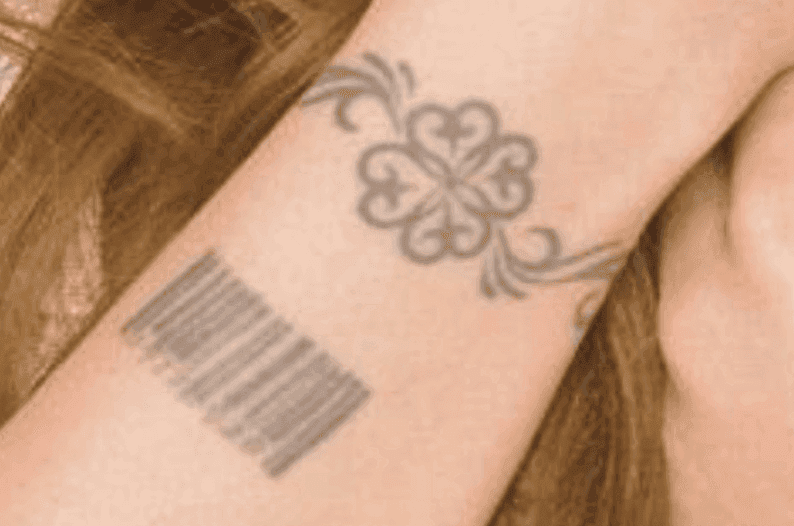
Near her right wrist, a design of four hearts arranged like a four-leaf clover sits next to a barcode. In the arms-crossed photo above, you can see both on the wrist in front of her chest.
Japanese Wikipedia and many fan sites say the barcode encodes her own date of birth, September 20, 1977. We found no statement from Amuro and no major media report that confirms it.
In general, people choose barcode tattoos to turn an important number, such as a birthday or anniversary, into a design. The four-leaf clover is a classic good-luck symbol (see our guide to good-luck tattoos).
Some sites, including Japanese Wikipedia, also say "Love Peace World" was later added to her right arm. We couldn't find a clear photo of her with it, or any news report about it.
Did Namie Amuro Remove Her Tattoos?
We found no statement from Amuro or her agency saying she had her tattoos removed. The idea comes from TV appearances and concert footage in which her tattoos often couldn't be seen.
The 2002 Kohaku Complaints
Kohaku Uta Gassen is NHK's annual New Year's Eve music show. According to Nikkan Gendai, viewers complained to NHK that her tattoo was visible during the 2002 show. At the 2003 show, no tattoo could be seen on her left arm, and people wondered whether she had covered it with stage makeup. (Source: Nikkan Gendai, September 22, 2017 (Japanese))
She did not appear on Kohaku again until 2017, when she sang "Hero" as a special guest in what was billed as her last appearance, 14 years after the previous one. (Source: Daily Sports, January 1, 2018 (Japanese))
Why She Stopped Doing TV Music Shows
Sankei Sports reported that from her late twenties, Amuro turned down TV music shows, Kohaku included, because she wanted to focus purely on music, and concentrated on concerts with no talking between songs, only singing and dancing. (Source: Sankei Sports, September 21, 2017 (Japanese))
Nikkan Gendai also mentions online speculation among some fans that she didn't want to perform with her tattoos covered. Amuro herself never linked her tattoos to her TV appearances.
Faded, or Just Covered?

The same 2017 Nikkan Gendai article says that on the cover of a women's fashion magazine published in 2015, her tattoos looked much fainter than before. It adds that when TV shows aired concert footage, the tattoo on her left arm often couldn't be seen, which led some people to guess she had it removed. (Source: Nikkan Gendai, September 22, 2017 (Japanese))
None of this confirms removal. We don't know whether she covered the tattoos with makeup or had them lightened with laser treatment. Since she retired in 2018 and returned to private life, nothing about them has been made public.
Tattoos in Japan
The Kohaku complaints are a reminder that tattoos are still sensitive on Japanese TV. Many hot springs, pools and gyms in Japan also restrict tattoos, and our article on why Japanese facilities ban tattoos explains the background. If you are visiting Japan with tattoos, you can search for places that accept them.
Frequently Asked Questions About Namie Amuro's Tattoos
When did Namie Amuro get her tattoos?
The HARUTO tattoo on her left upper arm was reported as new in 2002: she got it early that year and first showed it at a film screening on August 29, 2002. Japanese Wikipedia says she got the wrist tattoos in 1997 and 2001, but we couldn't confirm that in news reports from the time.
What does HARUTO on Namie Amuro's arm mean?
It is the name of her son, according to a 2002 report in ZAKZAK and a 2017 photo caption in Sankei Sports. The English text above it is said to be a message to her late mother.
Why do people think Namie Amuro removed her tattoos?
Because they couldn't be seen at the 2003 Kohaku or in much of her later concert footage, and a 2015 magazine cover showed them looking faded. Neither she nor her agency ever said she had them removed, so there is also no known reason.
How did people in Japan react to her tattoos?
Nikkan Gendai reported that some viewers complained to NHK after her tattoo was visible on Kohaku in 2002. Beyond that, we found no reliable data on how the public felt about them.
Why did Namie Amuro retire?
In an NHK documentary interview recorded before she retired and aired in January 2019, she said one goal was for fans to remember her while she was still in good form. She also revealed that she had damaged her vocal cords seven years earlier and had begun to feel she was reaching her limit. (Source: Sponichi, January 20, 2019 (Japanese))
What is Namie Amuro doing now?
She retired from show business on September 16, 2018. As of October 2026, we found no announcement of a comeback.
Summary: Namie Amuro's Tattoos
Namie Amuro's known tattoos are an oval of English text and her son's name, HARUTO, on her left upper arm, plus a clover-like design and a barcode near her right wrist. HARUTO was reported in 2002, and the English text is said to honor her late mother.
She never said she had them removed. Reports only describe them as faded or often not visible. If you are thinking of a name or a date of your own, compare lettering designs first, then talk it through with a studio.
*Based on publicly available information as of October 2026.