Japanese lucky charm tattoos draw on symbols Japan has long treated as lucky: dragons, koi, beckoning cats (maneki-neko), daruma dolls and more. Several are still sold as engimono (good-luck charms) at temples and shops. No tattoo can promise luck, but each of these symbols carries a traditional meaning with a long history. This guide explains what each one stands for, with sources, and how to choose one.
Key takeaways
- There is no evidence that a tattoo changes your luck or fate. A lucky tattoo carries the traditional meaning of its symbol
- Tattoos have long been worn to ward off misfortune, in Japan and around the world
- Japanese symbols: dragon (rain and protection), koi (success through effort), maneki-neko (customers and money), daruma (perseverance and wishes), snake (wealth and renewal), crane (long life)
- Charms from other cultures: four-leaf clover (luck), horseshoe (luck and protection), evil eye and hamsa (protection from the evil eye)
- In Japan, even a small tattoo can keep you out of some onsen, so plan size and placement
- Browse Japanese Traditional tattoo designs
Japanese Lucky Charm Tattoos at a Glance
Each symbol below is tied to a specific wish. The sections that follow explain where each meaning comes from.
| Symbol | Traditional meaning | Wish |
|---|---|---|
| Dragon | Brings rain, protects | Protection |
| Koi | Carp that became a dragon | Success |
| Maneki-neko | Beckons customers | Business, money |
| Daruma | Always gets back up | Perseverance |
| Snake | Linked to Benzaiten | Wealth, renewal |
| Crane | Lives a thousand years | Long life, marriage |
| Centipede | "Many feet" pun | Customers, money |
| Four-leaf clover | Rare lucky leaf | Luck |
| Horseshoe | Iron wards off evil | Luck, protection |
| Evil eye, hamsa | Deflects the evil eye | Protection |
On Tattoo Japan, users have posted 34 dragon designs, 33 snakes, 8 koi and 4 each of daruma and cranes (as of October 25, 2026).
Can a Tattoo Bring You Luck?
Tattoos as charms in history
Around the world, tattoos have been used not only as decoration but also to show group membership and to protect the wearer from misfortune. Tattoos as charms against evil are found in many places, and early examples from Japan appear in the Chinese chronicle Records of Wei. (Source: Kotobank, "入墨" (Britannica Japan and Heibonsha encyclopedias, in Japanese))
Writing about Edo-period Japan (1603–1868), when tattooed tobi (steeplejacks who also fought fires) were the pride of their neighborhoods, cultural anthropologist Yamamoto Yoshimi notes: "Dragon tattoos were favored as a kind of talisman, possibly because dragons were traditionally believed to bring rain." (Source: nippon.com, “Irezumi”: The Japanese Tattoo Unveiled (Jan 2017))
Will a tattoo change your fate?
We found no research or official source showing that a tattoo improves your luck or changes your fate, spiritual claims included. The meanings in this guide are traditions attached to good-luck charms and patterns, not promises.
A practical way to think about it: a lucky charm tattoo is a wish you carry with you, in a form whose story you know.
Can a tattoo bring bad luck?
There is no solid evidence for that either. In Japan, though, tattoos have real-world consequences. In a 2015 Japan Tourism Agency survey, about 56% of the 581 hotels and ryokan that replied did not let guests with tattoos use their baths, and about 13% allowed them on conditions such as covering up. (Source: Travel Voice, Oct 2015 (Japanese)) More on this in the onsen section below.
Japanese Good Luck Symbols for Tattoos
Dragon (ryu)
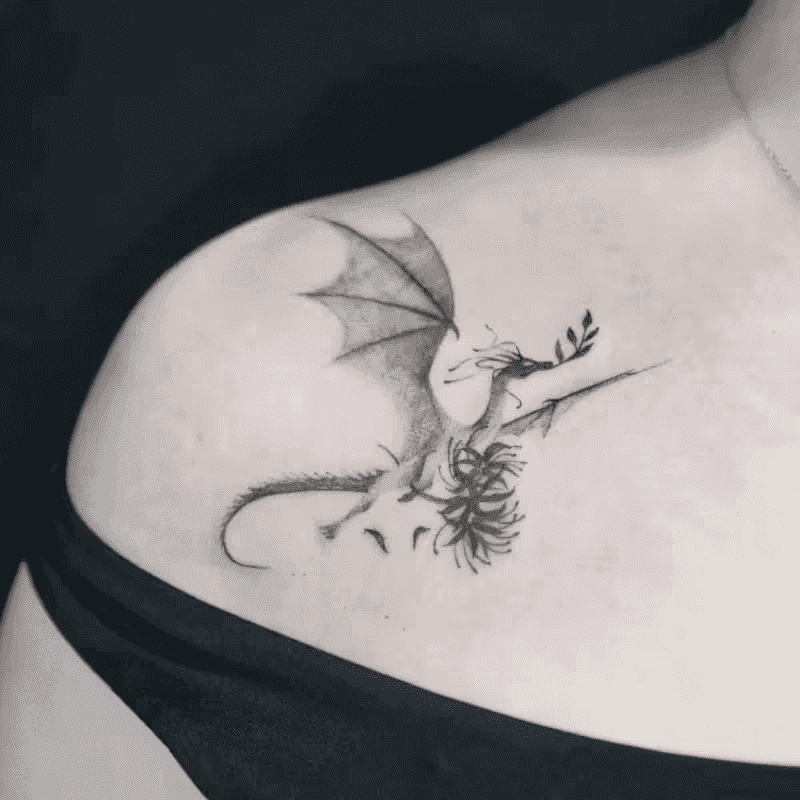
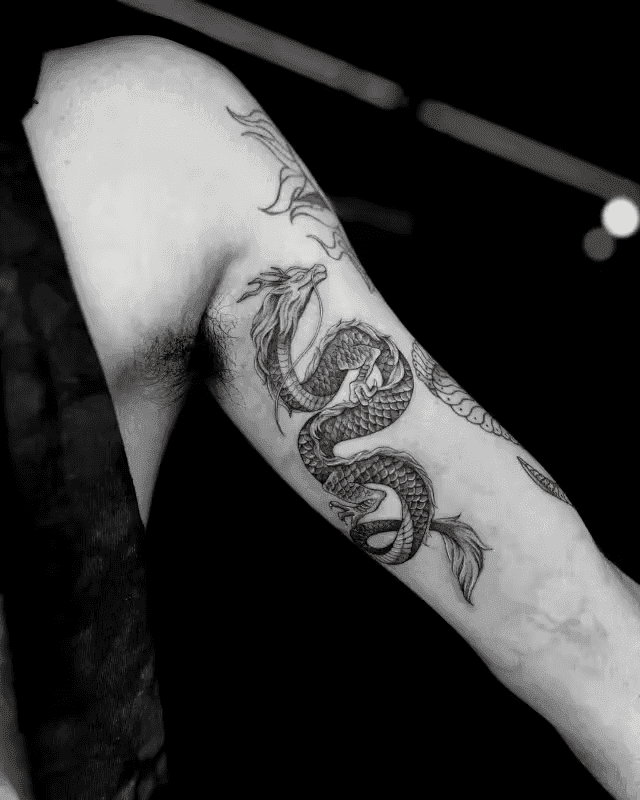
In East Asian art, the dragon is associated with water and is often shown emerging from clouds to produce rain. In Buddhist thought it became a protector of the Buddhas and the Buddhist law, and in ancient China dragons were painted on tomb walls to ward off evil spirits. (Source: JAANUS, "ryuu")
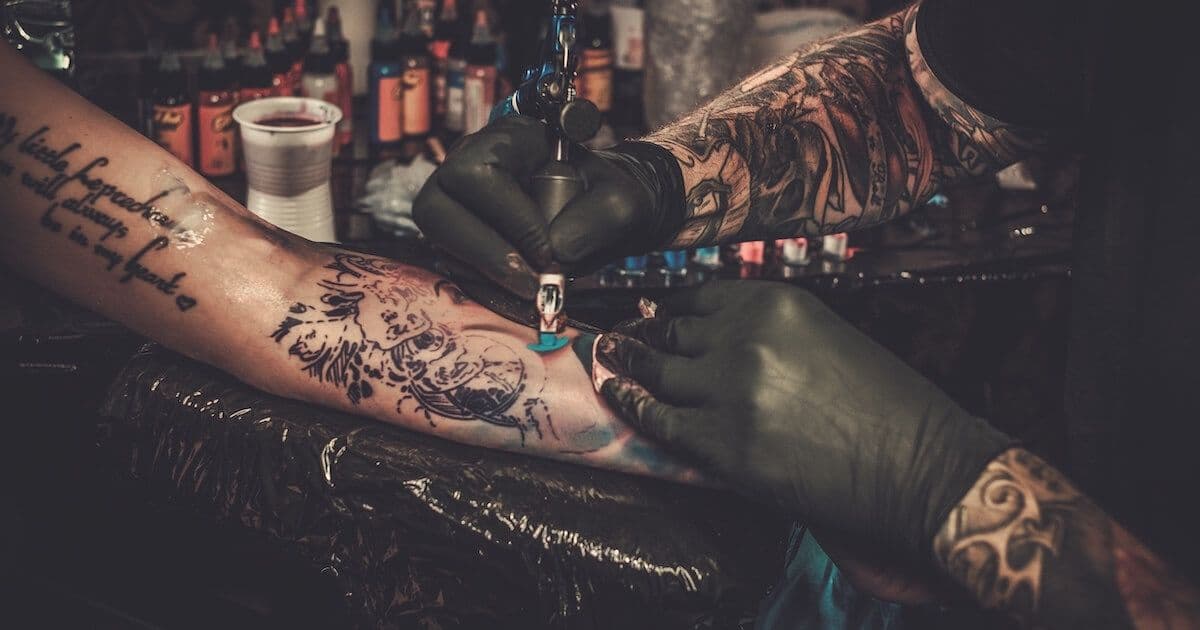
The winged dragon in the first photo comes from a different tradition. Western dragons usually guard treasure underground or in water and breathe fire, while the Eastern dragon is a rain-bringer. (Source: Kotobank, "竜" (Japanese))
Koi
The koi tattoo comes from koi-no-takinobori, "carp ascending a waterfall": a Chinese legend of a carp that became a dragon after swimming up a waterfall at the headwaters of the Yellow River. In Japan it is a classic image of effort leading to success, and it is linked to Boys' Day, when carp streamers are flown. (Source: JAANUS, "koi-no-takinobori")
A koi climbing toward a dragon in one design tells the whole story. Compare layouts in our koi tattoo designs.
Maneki-neko (beckoning cat)
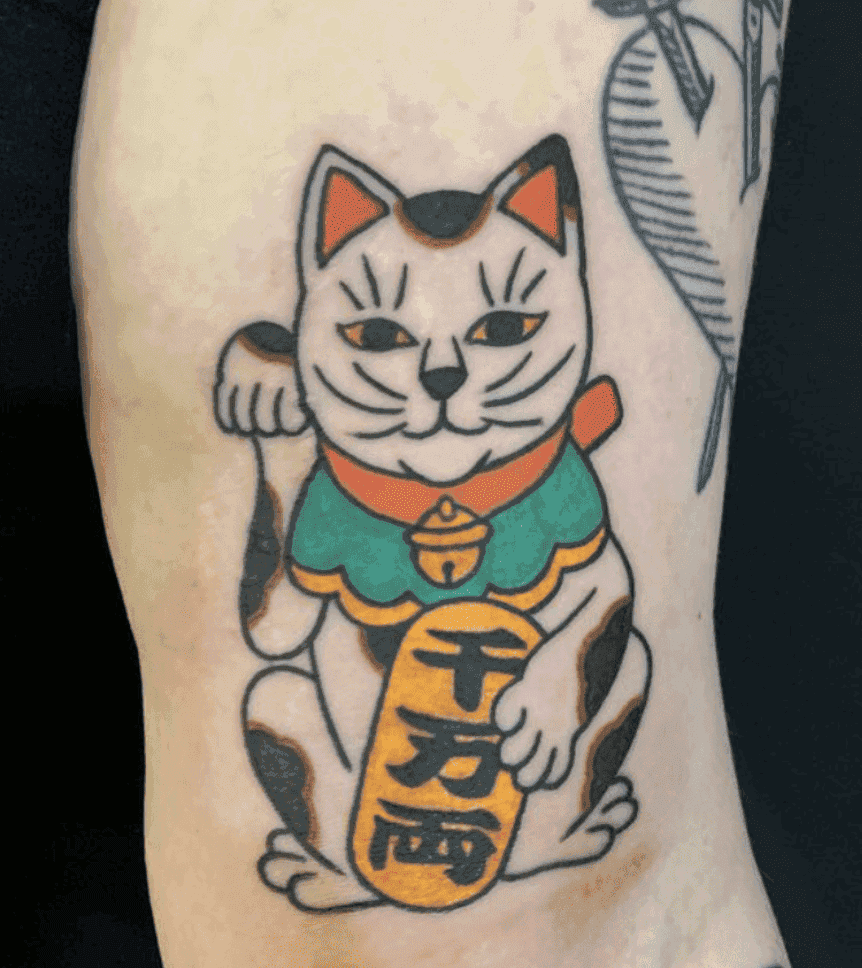
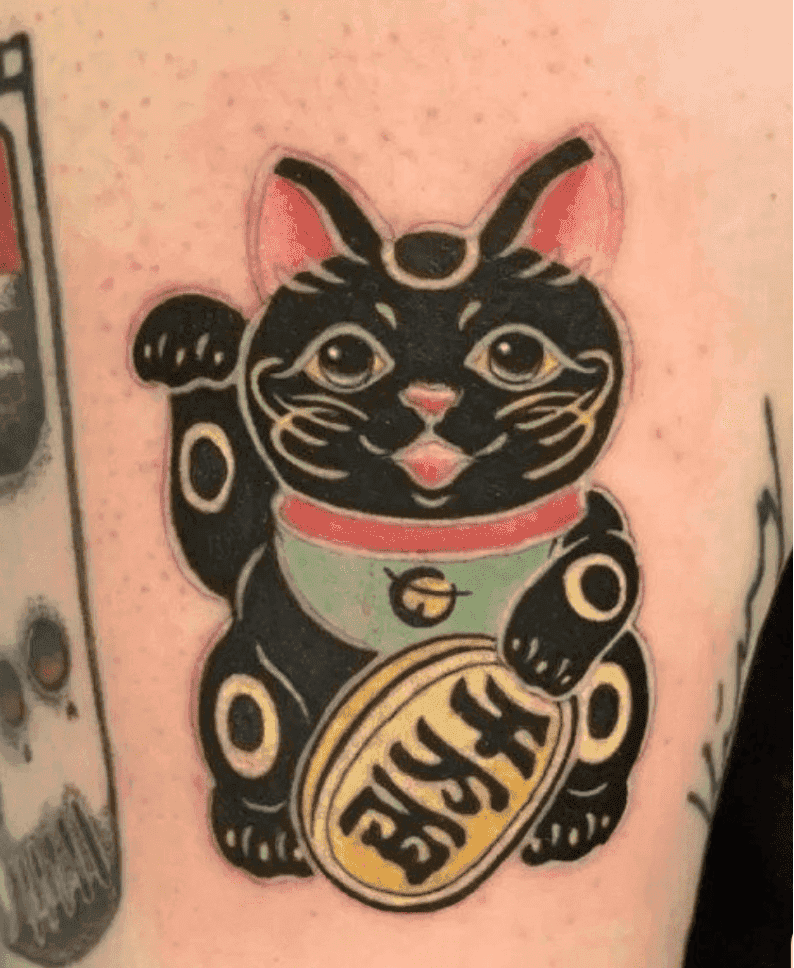
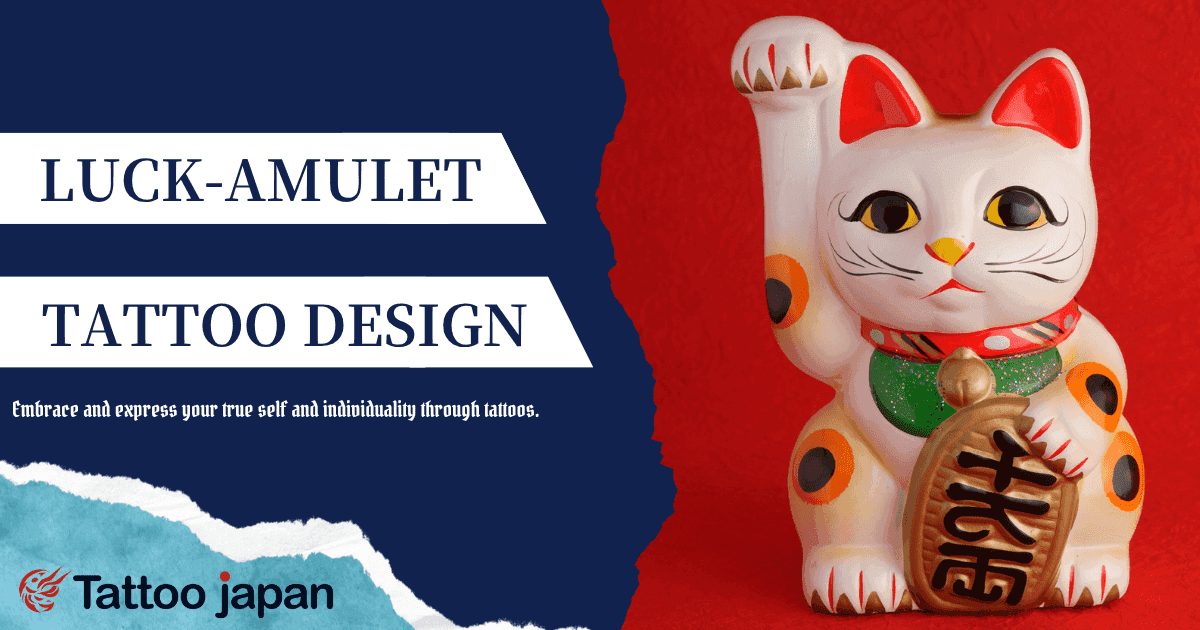
The maneki-neko is a figurine of a seated cat raising one front paw as if beckoning people in. Shops that depend on customers display it because it is believed to invite customers and treasure. One origin story says Gotokuji Temple in Setagaya, Tokyo, is the temple that Ii Naotaka, lord of the Hikone domain, entered after a cat beckoned him. (Source: Kotobank, "招き猫" (Japanese))
Which paw is raised matters: a raised left paw attracts customers, and a raised right paw ushers in money and good fortune. Color matters too. The black, red and white calico is the standard version, a black cat wards off bad luck or evil spirits, and gold is for money and wealth. A cat holding a koban, an old Edo-period gold coin, is the most common version in shops. (Source: Time Out Tokyo, June 22, 2018)
Both tattoos above raise the right paw and hold a koban. You can also see a hand-poked maneki-neko design posted on Tattoo Japan.
Daruma
The daruma is a papier-mâché doll modeled on Bodhidharma, the Buddhist monk, in seated meditation, and is considered a good-luck charm for prosperity and protection from misfortune. Shorinzan Daruma-ji Temple in Takasaki, Gunma Prefecture, is regarded as the birthplace of the lucky daruma. (Source: Highlighting Japan, Cabinet Office, Nov 2025)
Its weighted base makes it spring back up when knocked over, which is why it is tied to the proverb nana korobi ya oki, "fall down seven times, get up eight." (Source: Kotobank, "達磨" (Japanese))
At Shorinzan Daruma-ji, a monk first places a pupil in one eye. Visitors then take the doll home, complete the left eye while making a wish, and draw the right eye once the wish comes true or the year has passed safely. The temple's deputy chief priest explains that the eyebrows are shaped like two cranes and the mustache like two turtles, and the belly usually reads fuku-iri, "filled with good fortune." (Source: Highlighting Japan, Nov 2025)
In a tattoo, a daruma with one eye can stand for a wish in progress, and one with both eyes for a wish fulfilled.
Snake (hebi)
Because snakes hibernate and shed their skin, they have long been linked with longevity and renewal. In Japan they were revered as deities of water. From the Middle Ages, the goddess Benzaiten and the serpent deity Ugajin were viewed as one and the same, and both were labeled deities of wealth. (Source: nippon.com, Jan 2, 2025) That is why snakes are often connected with money luck in Japan.
Crane (tsuru)
"The crane lives for a thousand years, and the turtle for ten thousand years" is a well-known Japanese proverb. (Source: Victoria and Albert Museum) Cranes are also a symbol of a happy marriage, because they are said to stay with one partner for life. (Source: National Diet Library, NDL Image Bank (Japanese))
Centipede (mukade)
In Japanese folk belief, the centipede is a messenger of Bishamonten, one of the Seven Lucky Gods. Its many legs also make it a lucky pun on kyaku-ashi (customer traffic) and o-ashi (a colloquial word for money), so some performers and merchants traditionally avoid killing centipedes. (Source: Kotobank, "ムカデ" (Japanese)) See our centipede tattoo guide for designs.
Lucky Charms from Other Cultures
Four-leaf clover
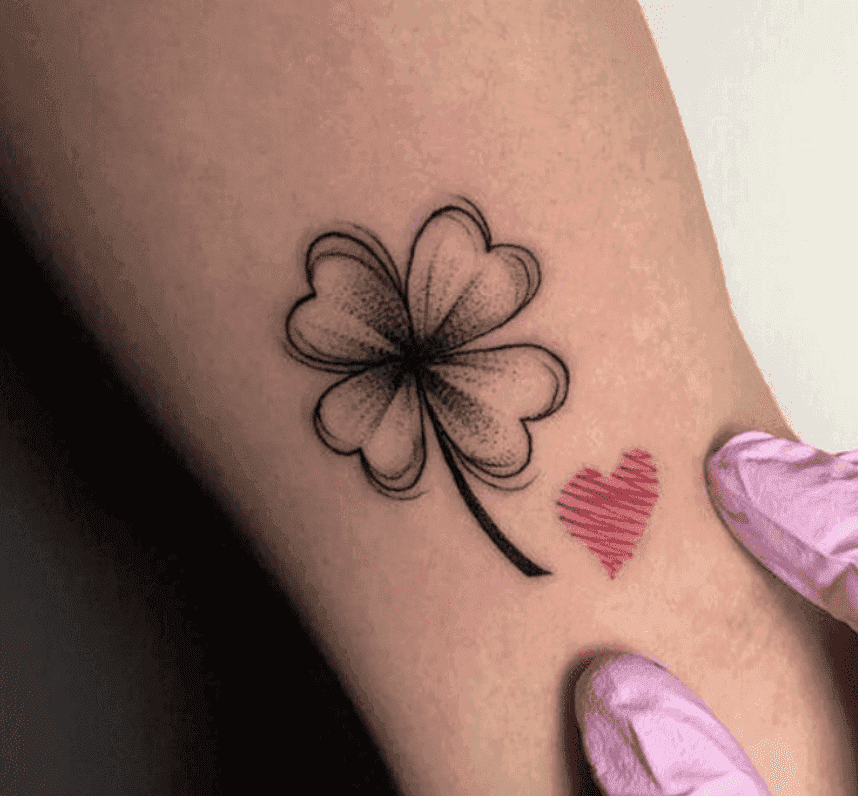
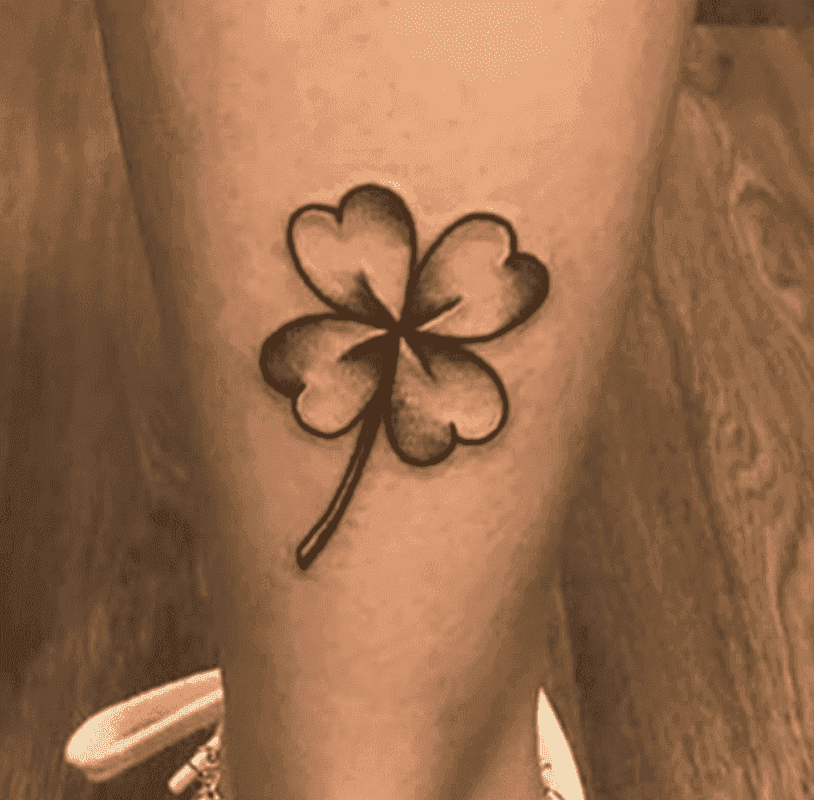
London's Science Museum holds a small glass amulet combining a heart and a four-leaf clover, both "strongly associated with good luck." It was reputedly carried by a soldier from a London regiment during the First World War. The first tattoo above pairs the same two shapes. (Source: Science Museum Group, Heart-shaped amulet)
Four-leaf clovers form when the developing leaflets are physically damaged or when a genetic change occurs. (Source: Chubu University, "Shirotsumekusa" (PDF, Japanese)) You will often read that each leaf stands for something, such as hope, faith, love and luck, but we could not find a reliable source for where that reading comes from.
Horseshoe
Horseshoes have long been associated with good luck. They were originally made of iron, a material long believed to repel evil spirits, and were traditionally fixed with seven nails, seven being a lucky number in many cultures. (Source: Science Museum Group, Copper horseshoe shaped amulet)
You can find horseshoe charms in Japan too, for example at Baba Hikawa Shrine in Niiza, Saitama Prefecture. (Source: Saitama Prefecture, Jan 2026 (Japanese))
Evil eye (nazar) and hamsa
The evil eye is the belief that someone can cause harm, misfortune or plain bad luck through a malicious glance. Amulets against it usually include an eye-shaped design. Glass eye beads, called nazars, are one of the commonest forms and are found especially around the Mediterranean, Central Asia and the Middle East. (Source: Science Museum Group, Glass amulet)
The hamsa (also spelled khamsa) is a hand-shaped amulet. The Museum of International Folk Art in Santa Fe holds one woven from blue glass beads, recorded as worn on boys' foreheads to protect them from the evil eye. (Source: Museum of International Folk Art)
The two symbols are sometimes combined, as in this hamsa with an eye in the palm posted on Tattoo Japan. See more eye tattoo designs.
How to Choose a Lucky Charm Tattoo
Start with the wish
Pick the wish first, then the symbol whose tradition matches it (see the table at the top). Many symbols carry more than one meaning, so decide which one you mean before you talk to an artist.
Color: no universal rules
Color meanings are not universal. They belong to specific charms and places. In Koshigaya, Saitama Prefecture, the five-color daruma assigns purple to long life, white to good fortune and passing exams, red to good luck and warding off misfortune, yellow to money, and green to safety and health. (Source: Saitama Prefecture, Jan 2026 (Japanese)) Maneki-neko colors follow their own rules, as above.
Since the meaning comes from the symbol, not the ink, an all-black black and grey piece carries the same story.
Placement: visibility over luck
We found no reliable source that ties luck to a particular body part. Choose placement by how often you want to see the tattoo and how easily you need to cover it:
- To see it every day: the wrist or inner arm
- To keep it under clothes: the back or ankle
- If you plan to visit onsen in Japan: a smaller piece in a spot that is easy to cover
Lucky Tattoos and Japan's Onsen Rules
The Japan Tourism Agency tells visitors that tattoo policies differ widely from ryokan to ryokan. It explains that many Japanese associate tattoos with organized crime, which is why people with tattoos have been banned from most public bathing facilities. Some ryokan, however, have no restrictions or decide case by case (one or two small tattoos may be fine), and many offer private baths that guests with tattoos can use. (Source: Japan Tourism Agency, Questions for Ryokan)
A lucky charm doesn't change these rules. Check each facility before you go.
Lucky Charm Tattoo FAQ
Can a tattoo really bring good luck?
There is no evidence that it can. A lucky charm tattoo carries a traditional meaning, so treat it as a personal reminder of a wish rather than a guarantee.
Which lucky charm tattoo is best for money?
By tradition, a maneki-neko with its right paw raised is for money and good fortune, the snake is tied to Benzaiten as a deity of wealth, and the centipede is a pun on customers and money. None of these meanings are specific to men or women. None of them will make you richer, either.
What is the Japanese symbol for good luck?
There is no single one. Japan has many engimono (good-luck charms), such as the maneki-neko and daruma. The kanji 福 (fuku, good fortune) usually appears on a daruma's belly in the phrase fuku-iri, "filled with good fortune."
Where can I get a Japanese lucky charm tattoo in Japan?
Browse designs first to find a style you like, then contact a studio that works in it. You can search tattoo studios across Japan by area.
Choosing a Lucky Charm That Means Something
Japanese lucky charm tattoos draw on centuries of good-luck symbols: the rain-bringing dragon, the koi that became a dragon, the beckoning maneki-neko, the daruma that always gets back up, the snake linked to Benzaiten and the long-lived crane. Charms from elsewhere, like the four-leaf clover, horseshoe and evil eye, have their own long histories.
None of them can promise luck. Choose the symbol whose story matches your wish, then pick the size and placement for how you live, especially if onsen are part of your plans.
This article is based on publicly available information as of October 2026 and designs posted on Tattoo Japan as of October 25, 2026.