



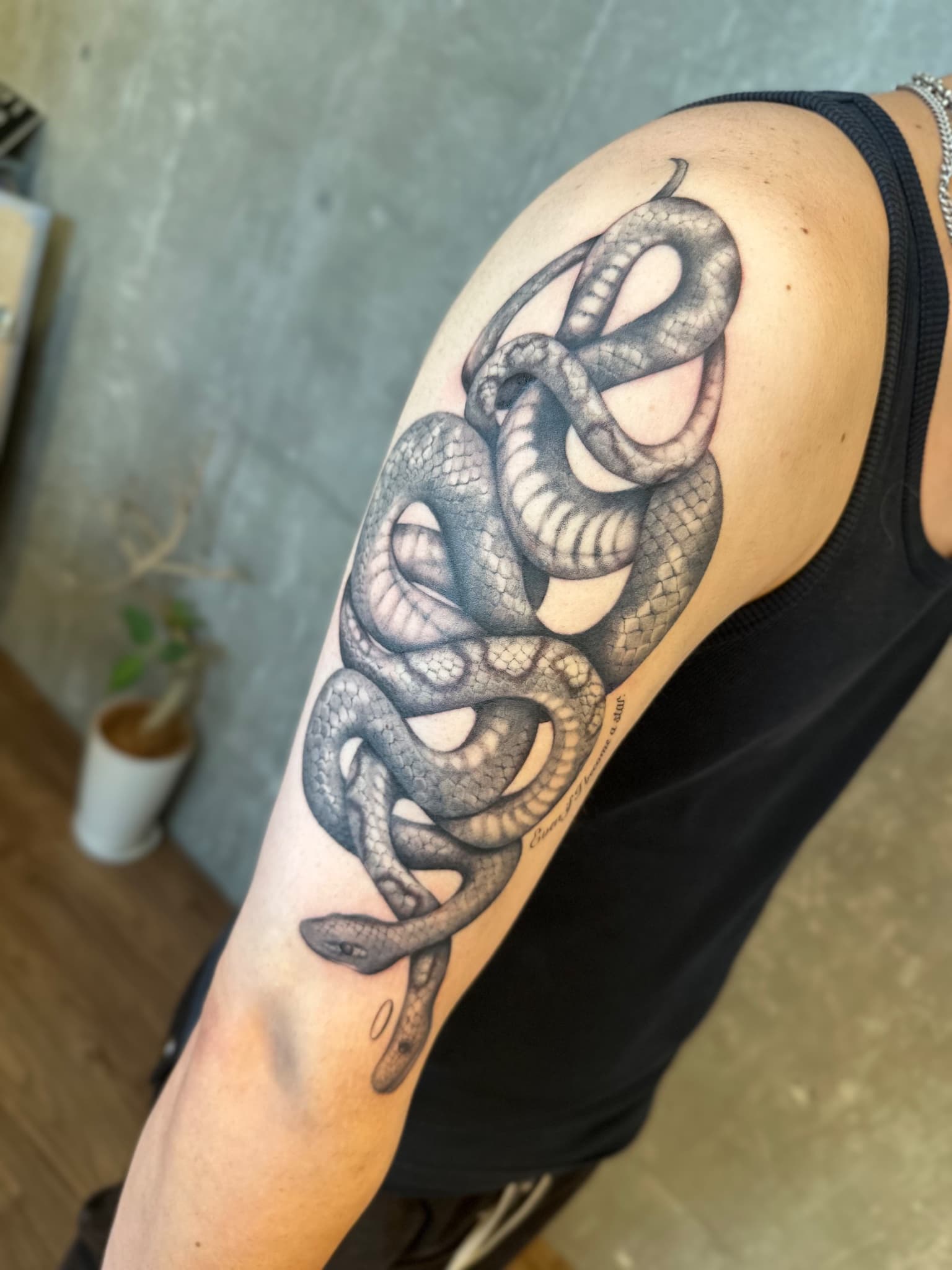


What a Snake Tattoo Means
A snake tattoo has no single, fixed meaning. Snakes do appear again and again in Japanese and Western belief, though, and reference works link them to rebirth, water gods, healing and temptation. Here is what the sources actually say, with a focus on the snake in Japan.
Shedding skin: a symbol of rebirth
Because a snake sheds its skin again and again and comes out renewed, Western tradition made it a symbol of rebirth and immortality. (Source: Kotobank, "Hebi" (snake), Heibonsha World Encyclopedia, in Japanese)
In Japan, snakes depicted on pottery from the prehistoric Jomon period are the earliest suggestion of their spiritual role. Mythologist Hirafuji Kikuko explains that the way snakes slough off their skin in one piece "led many cultures to consider them emblems of death and rebirth." (Source: nippon.com, "Serpent Tales: Snakes in Japanese Mythology and Folklore," Jan 4, 2025)
Water gods and Benzaiten in Japan
When wet rice farming spread in the Yayoi period, snakes were a common sight around paddies and irrigation canals, which tied them to water. According to Hirafuji, they came to be revered "both as messengers of deities and as guardians of waterways and farmlands in their own right." (Source: nippon.com, Jan 4, 2025)
White snakes are held especially sacred as messengers of the gods, and are also said to serve Benzaiten (Benten), one of the Seven Lucky Gods. (Source: Kotobank, "Hebi," Heibonsha World Encyclopedia and Encyclopedia Nipponica, in Japanese)
Benzaiten's original form was said to be a snake deity. In the Edo period, people prayed to her as a goddess of saving money, and her name came to be written with the character for "wealth." (Source: Kotobank, "Benzaiten," Heibonsha World Encyclopedia, in Japanese) For more lucky motifs, see our guide to Japanese lucky charm tattoos.
Healing, wisdom and temptation in the West
The World Health Organization's emblem shows a staff with a snake coiling round it. In WHO's own words, "the staff with the snake has long been a symbol of medicine and the medical profession," and it comes from the story of Asclepius, the Greek god of healing. (Source: WHO, "The WHO Logo and Emblem")
The Bible tells readers to be "wise as serpents," and the snake has long stood for cleverness. The serpent of the Garden of Eden, on the other hand, represents evil, and temptation above all. (Source: Kotobank, "Hebi," Heibonsha World Encyclopedia, in Japanese)
Two snakes, and the snake that bites its tail
Two snakes climbing a staff make the caduceus, best known as the staff of the Greek god Hermes. (Source: Kotobank, "Caduceus," Heibonsha World Encyclopedia, in Japanese) The WHO emblem above, by contrast, has a single snake on the staff of Asclepius.
A snake biting its own tail to form a ring is the ouroboros. A circle has no beginning and no end, so the ouroboros came to stand for completeness, eternity and immortality. (Source: Kotobank, "Ouroboros," Encyclopedia Nipponica, in Japanese)
The Dojoji serpent and the hannya mask
In the legend of Dojoji, a temple in Wakayama Prefecture, a young woman named Kiyohime is so consumed by rage and obsession that she turns into a giant serpent. She chases the monk Anchin, coils around the temple bell and burns him to death. In the Noh play Dojoji, a woman in serpent form emerges from the bell. (Source: Kotobank, "Dojoji," Britannica Japan, in Japanese)
The hannya, the two-horned mask of a demon woman, is used in Dojoji and other Noh plays. (Source: Kotobank, "Hannya," Daijisen and Mypedia, in Japanese) Two of the snake designs on Tattoo Japan pair the snake with a hannya mask (as of November 18, 2026).
Snake Tattoo Designs on Tattoo Japan
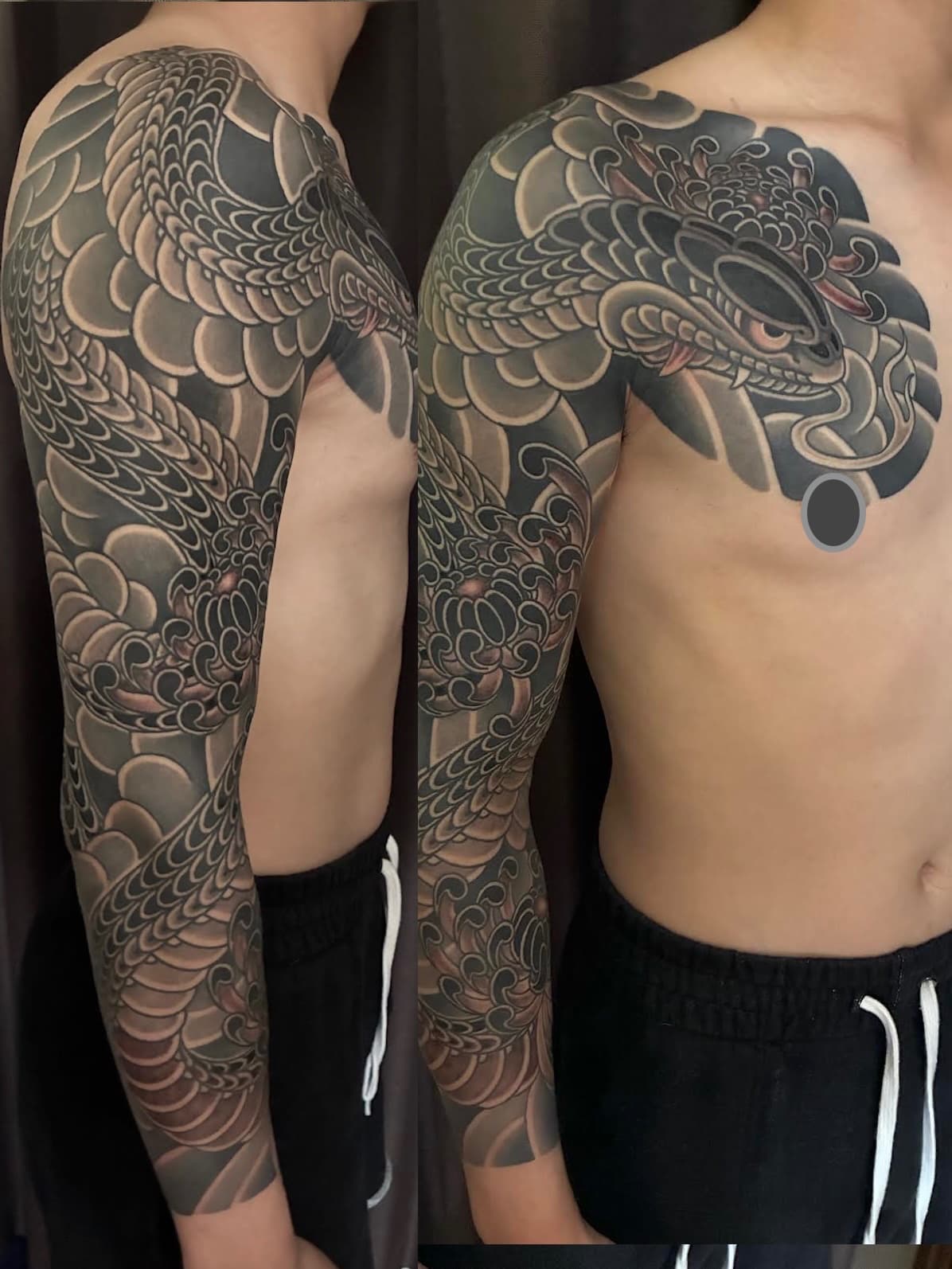
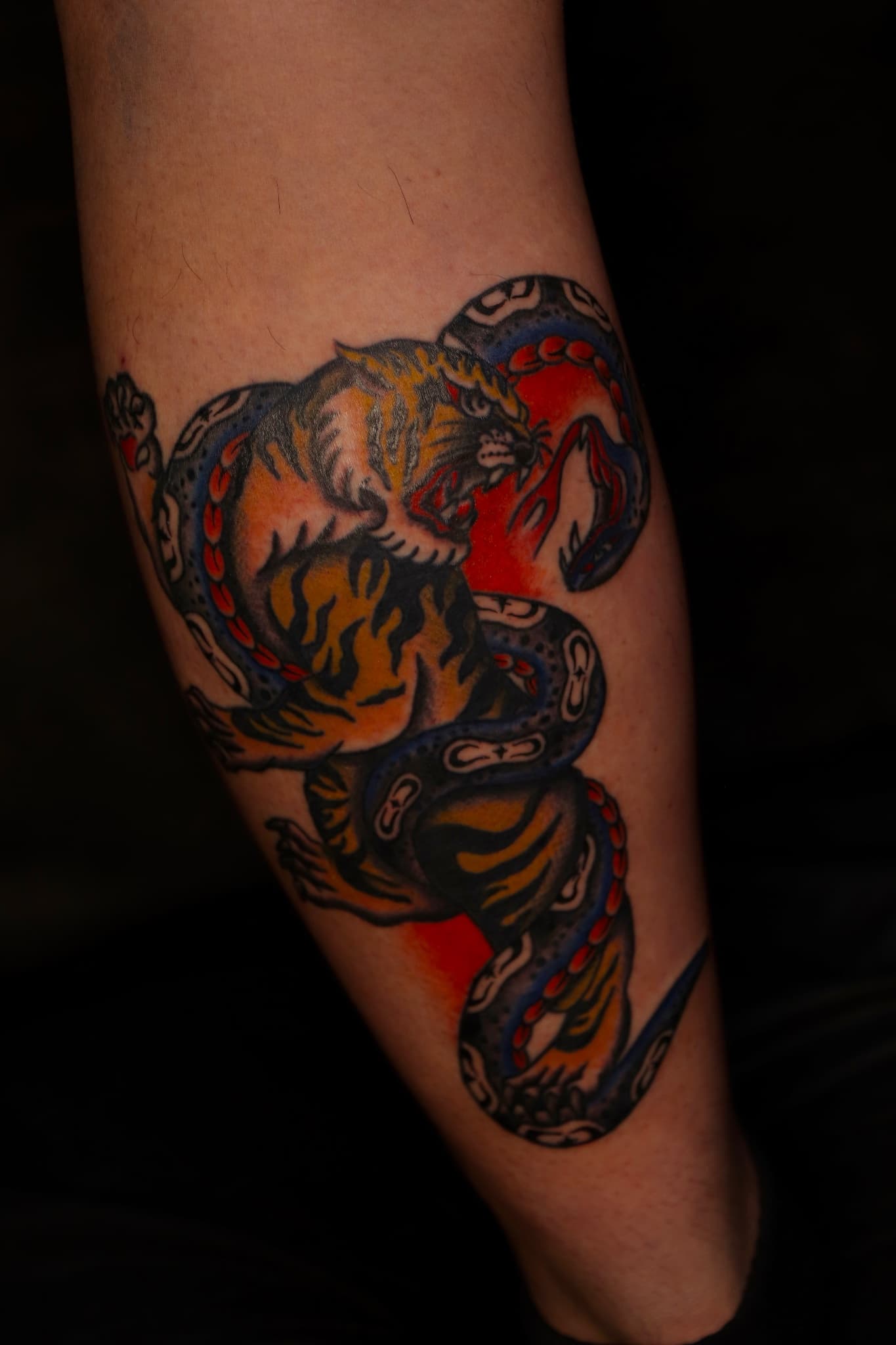
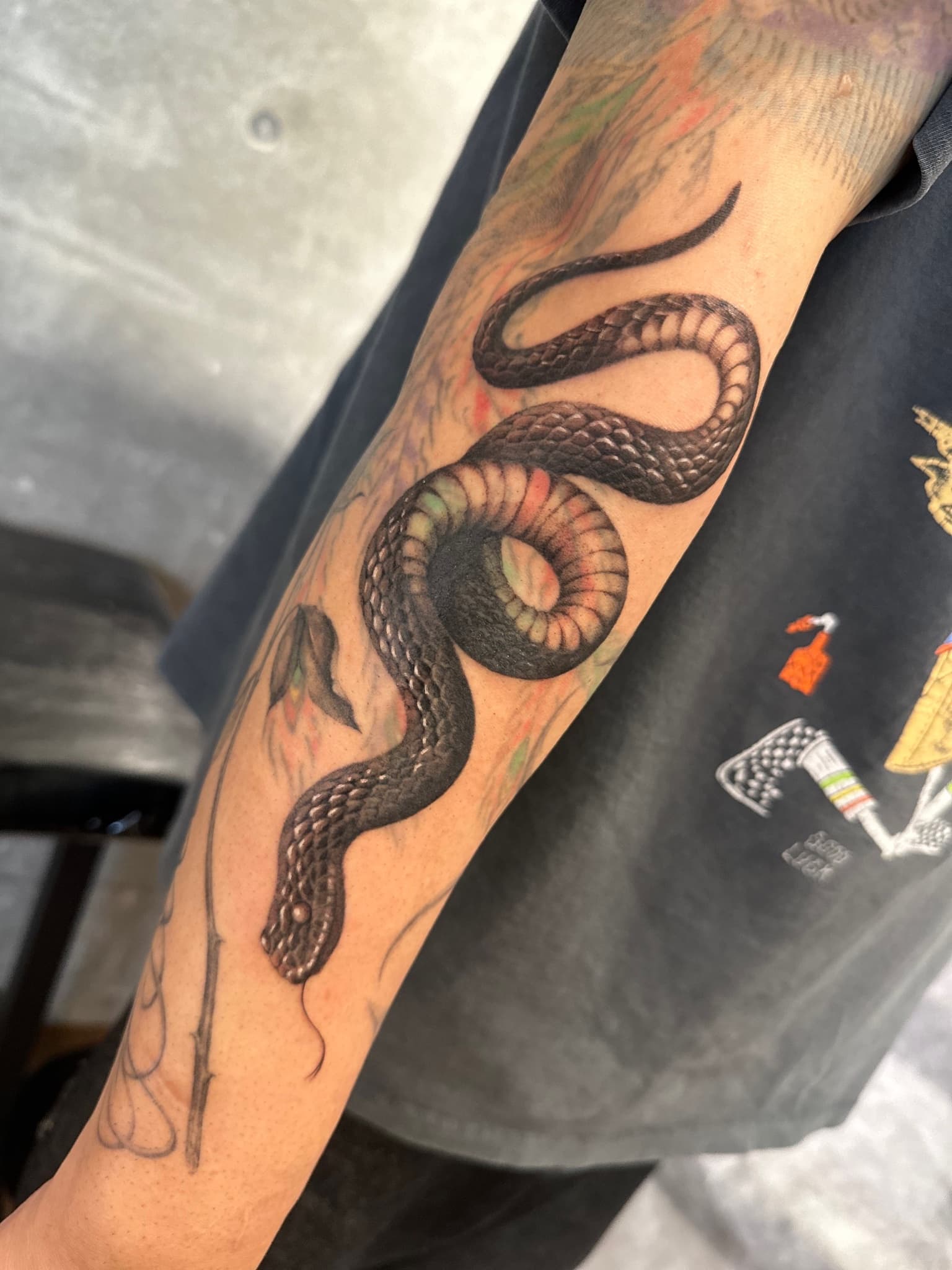
Tattoo Japan has 33 snake designs (as of November 18, 2026). Twenty are on the arm, 8 on the leg and 3 on the abdomen. A snake's long body can follow the line of an arm or leg, or wrap around it.


Nineteen of the 33 are black and grey work, shaded in tones of black, and 9 are Japanese traditional. Some of the Japanese pieces add chrysanthemums, peonies or a hannya mask.
Snakes with flowers
Eleven of the 33 designs combine a snake with flowers. The pairing has no fixed meaning. For the background of individual flowers, see flower tattoo designs.


Snake Tattoo FAQ
Is a snake tattoo bad luck?
There is no single answer. The serpent of Eden stands for evil and temptation, but in Japan snakes were honored as water gods and their messengers, and white snakes as messengers of Benzaiten. The snake is also an emblem of medicine. Which side your tattoo carries is your choice.
Does a snake tattoo mean something different for men and women?
No rule says it does. Of the 33 snake designs on Tattoo Japan, 14 are tagged "men" and 10 are tagged "women" (as of November 18, 2026; some carry both tags).
What does a snake and butterfly tattoo mean?
There is no fixed meaning. Both animals change form, though: the snake sheds its skin, and the butterfly passes through egg, larva and pupa before it becomes an adult. (Source: Kotobank, "Cho" (butterfly), Encyclopedia Nipponica, in Japanese) Tattoo Japan has no design combining the two yet. See butterfly tattoo designs for the butterfly side.
Does the placement change the meaning?
No placement carries a fixed meaning. On Tattoo Japan, 20 snake designs are on the arm, and none is on the ankle yet (as of November 18, 2026). Browse arm tattoo designs to compare placements.