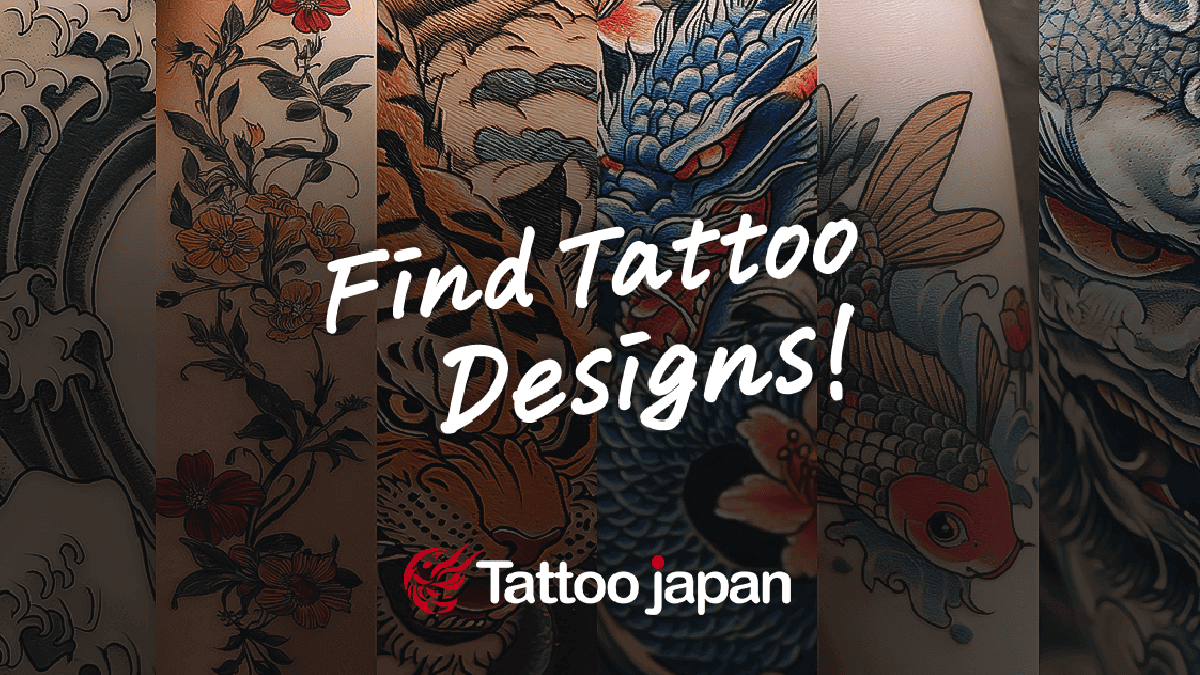
Most tattoo motifs come with a meaning people commonly attach to them: the moon for change, the snake for rebirth, the koi for perseverance. None of these are fixed rules, and the meaning that matters most is the one you bring to your own tattoo. This guide lists common tattoo meanings at a glance, the stories behind seven popular quote tattoos, Japanese motifs such as the dragon, koi and hannya, and how people choose a placement, illustrated with designs shared in the Tattoo Japan gallery.
Key points
- The table below gives quick answers: moon = change and renewal, star = hope and guidance, snake = rebirth and healing, tiger = strength and protection
- For quote tattoos, phrases with a clear origin, like Muhammad Ali's "Float like a butterfly, sting like a bee," are the easiest to explain
- Japanese motifs have their own traditions: the koi stands for rising in the world, and dragons were worn as talismans in Edo-period Japan
- No placement has a fixed meaning. Choose by how visible you want the tattoo to be, and remember that visible tattoos can still keep you out of some baths in Japan
- Browse tattoo designs on Tattoo Japan
Once you know what you want to say, browse by motif in the Tattoo Japan gallery, from lettering designs to koi tattoo designs.
Tattoo Meanings at a Glance
These are the meanings most often attached to each motif. Select a motif to see designs shared on Tattoo Japan.
| Motif | Common meanings |
|---|---|
| Moon | Change, renewal, hope |
| Star | Hope, guidance, dreams |
| Sun | Vitality, passion, new beginnings |
| Butterfly | Transformation, growth, freedom |
| Rose | Love, passion, beauty |
| Lotus | Purity, rising above hardship |
| Cherry blossom | Transience, beauty, fresh starts |
| Spider lily | Farewell, death, hope of reunion |
| Peony | Wealth, prosperity, splendor |
| Angel | Protection, guidance, faith |
| Devil | Inner darkness, defiance, warding off evil |
| Two-face | Duality, joy and sorrow |
| Snake | Rebirth, healing, vitality |
| Cat | Independence, freedom, good fortune |
| Tiger | Strength, courage, protection |
| Dragon | Power, protection, a talisman |
| Koi | Perseverance, rising in the world |
| Phoenix | Good omens, auspicious times |
| Hannya | A woman's jealousy and rage |
| Spider | Patience, planning, creativity |
| Swallow | A safe return home |
| Chicano | Family, faith, heritage |
| Tribal | Protection, strength, rites of passage |
| American traditional | Sailor symbolism |
| Lettering | Whatever the words say |
These are general meanings, not rules. The same motif can mean different things in different countries, eras and styles, and in the end your tattoo means what you put into it.
Placements work the same way. Here is why people tend to choose each one, with more detail in the placement section below.
| Placement | Why people choose it |
|---|---|
| Behind the ear | Easy to hide under hair |
| Wrist | You see it every day |
| Fingers | Small and personal |
| Chest | Close to the heart |
| Arm | Easy to show, lots of space |
| Back | Room for a large piece |
| Ankle | Small and easy to cover |
Meaningful Quote Tattoos and Where They Come From
With lettering, the words carry the meaning. Here are seven short English phrases, six of them shown in designs shared on Tattoo Japan.
Single words work too: Hope, Faith, Courage, Believe, Breathe, Grateful, Fearless and Strength are all short and easy to read.
Whatever you choose, check the spelling in a dictionary and ask to see the stencil before the needle starts. A single wrong letter is hard to fix once it is in your skin.
"Float like a butterfly, sting like a bee"

Muhammad Ali's best-known line sums up how he boxed: light on his feet, sharp with his punches. He used the rhyme to taunt Sonny Liston before their world heavyweight title fight in February 1964, and it is credited to his cornerman Drew "Bundini" Brown. (Sources: Boxing News, August 22, 2020; Wikipedia)
As a tattoo it is usually done in flowing script, sometimes with a butterfly and a bee drawn in, as a reminder to stay light and hit hard when life gets tough.
"Get busy living or get busy dying."

This is a line from the 1994 film The Shawshank Redemption, spoken by the prisoner Andy Dufresne (Tim Robbins). The film is based on a Stephen King novella. (Sources: No Film School, January 8, 2026; Wikipedia)
People choose it as a push to keep moving forward instead of just getting by.
"Have faith."

Keep believing, and don't give up hope. It can be a statement of religious faith, but it works just as well as a reminder to trust yourself or someone you love.
Pairing a short phrase with a flower or symbol, as in this design, lets the picture and the words share one meaning.
"Art never comes from happiness."
Roughly: great art grows out of struggle, not comfort. It appeals to people who make things, and to anyone who wants to mark getting through a hard time.
We couldn't confirm who first said it, so be wary of the attributions you see online.
"Die with memories, not dreams."

Don't leave the things you want to do as daydreams; go out and make the memories. It reads as a promise to yourself to live without regrets.
We couldn't trace it to a single author.
"Do what you love."

Simple and direct: choose what you love over what is expected of you.
At four short words, it fits on a wrist, ankle or forearm.
"Dream without fear, love without limits."

It pairs the courage to chase your dreams with generosity toward the people in your life.
Splitting it over two lines, as in this design, shows off its two matching halves.
Tattoo Styles With a Meaning of Their Own
Some styles carry meaning in the look itself, because of where they came from.
Chicano Tattoo Meaning

The black-and-gray style of Chicano tattoos has its roots in the Chicano (Mexican American) culture of East Los Angeles. It uses only black and gray, with fine lines and soft shading that can look like a black-and-white photo.
It grew out of prisons, where there was no color ink. Inmates built homemade machines with a single needle and watered black ink down to get gray. In the mid-1970s, a tattoo shop in East Los Angeles began offering the same single-needle look to its mostly Mexican American customers, and the style moved into the mainstream. (Source: NPR, April 15, 2018)
In prison, the Chicano tattoo artist Freddy Negrete decorated stationery for fellow inmates with roses, Catholic and Aztec symbols, and portraits of women dressed as Mexican revolutionaries. In his memoir, he describes his own tattoos, a mix of Aztec, Mexican revolutionary and cholo imagery, as "our myths, the marks of our culture." (Source: same)
Tribal and Polynesian Tattoo Meaning

Tribal tattoos are bold, all-black designs based on the patterns of the Pacific Islands and other traditional cultures.
In the original traditions, tattoos marked status and life stages. In Samoa, the pe'a, which covers a man's body from the waist to the knee, is often described as a rite of passage; afterward, a young man is accepted as a full member of the association of young men. Some researchers link the tattoo to wrapping and defending the body. (Source: Te Papa, Museum of New Zealand)
In Polynesian-style designs, shark teeth are generally read as protection and strength, turtles as long life and family, and waves as change and the flow of life.
American Traditional Tattoo Meaning

American traditional uses heavy black outlines and a few bright colors such as red, yellow and green.
Many of its classic images come from sailor tattoos, and each has a meaning passed down at sea. (Source: We Are The Mighty, May 13, 2018)
- Swallow: earned for every 5,000 nautical miles at sea
- Anchor: crossed the Atlantic, or served in the merchant marine
- Nautical star: a sailor will always find his way home
Today people choose them for the broader ideas behind them: home, stability and finding your way.
Small Symbols: Moon, Star, Sun and Butterfly
These motifs work at any size, including tiny one-point tattoos.
Moon Tattoo Meaning

Because it waxes and wanes, the moon usually stands for change and renewal. As a light in the dark, it also stands for hope and guidance.
Some people choose the phase to match what they want to say:
| Phase | Common meaning |
|---|---|
| New moon | A new beginning |
| Crescent | Growth, still filling out |
| Full moon | Completion, fulfillment |
Of the 27 moon designs shared on Tattoo Japan, 11 are on the arm and 5 each on the chest and leg (as of October 23, 2026). Moons pair well with stars or, as in one gallery design, a cat.
Star Tattoo Meaning

Stars have guided travelers through the night, so they stand for guidance, hope and dreams.
The nautical star comes from sailor tattoos and stands for always finding your way home. (Source: We Are The Mighty) A shooting star is a wish, and a constellation often marks a birthday or star sign.
Sun Tattoo Meaning
The sun gives light and warmth to everything that lives, so it stands for vitality, energy and passion.
A rising sun suggests a new beginning, and a sun paired with a moon balances opposites such as day and night.
Butterfly Tattoo Meaning

A caterpillar becomes a chrysalis and then a butterfly, so the butterfly stands for transformation and growth. Its flight adds freedom.
Of the 71 butterfly designs shared on Tattoo Japan, 34 are on the arm, 10 on the chest and 9 on the leg (as of October 23, 2026).
Flower Tattoo Meanings
Each flower has its own meaning, and Japanese flower language (hanakotoba) does not always match Western traditions. Here are the meanings most often given.
Rose Tattoo Meaning

The rose is the classic flower of love and beauty. Red usually means love and passion, white means purity.
Because it has both a beautiful bloom and sharp thorns, some people use it for love that came through pain. Of the 79 rose designs shared on Tattoo Japan, 32 are on the arm, 17 on the leg and 8 on the chest (as of October 23, 2026).
Lotus Tattoo Meaning

The lotus grows out of mud and opens a clean flower. In Japanese, "a lotus in the mud" describes someone who stays pure in a corrupt environment, and in Buddhism the lotus is closely tied to the Pure Land paradise. (Sources: Kotobank, "a lotus in the mud"; Kotobank, "lotus"; both in Japanese)
As a tattoo, it stands for purity, rising above hardship and inner growth.
Cherry Blossom Tattoo Meaning
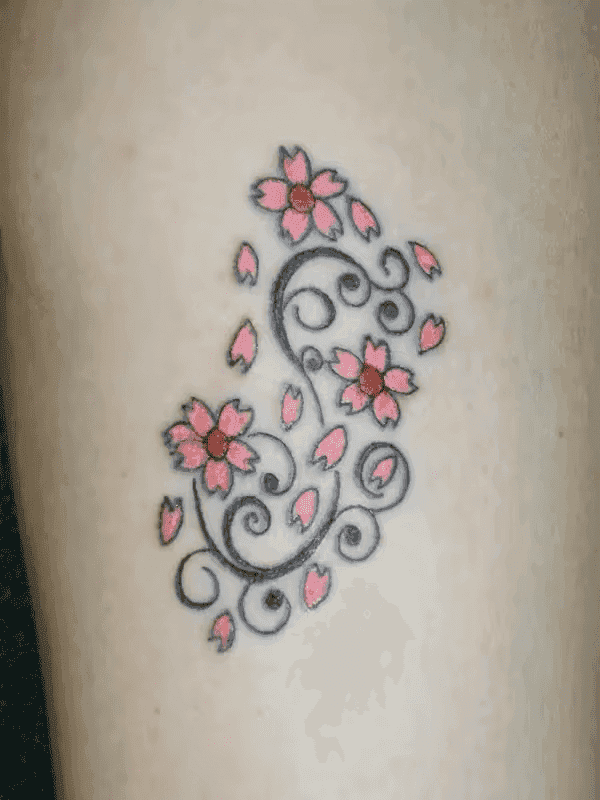
Cherry blossoms bloom briefly and fall fast, so they stand for the beauty of the moment and the shortness of life. They open in spring, which adds the idea of a fresh start.
As Japan's best-known flower, sakura also appear often in Japanese-style tattoos.
Spider Lily Tattoo Meaning

The red spider lily (higanbana) blooms around the autumn equinox. In Japanese it is also called manjushage and shibitobana, "the flower of the dead," and it often grows in temple grounds and cemeteries. (Source: Kotobank, in Japanese)
Those names and places tie it to farewell and death in Japan. In tattoos it is chosen to remember someone who has died, to close a chapter, or to hope for a reunion.
Other Flowers
| Flower | Common meaning |
|---|---|
| Sunflower | Warmth, admiration |
| Lily | Purity, dignity |
| Peony | Wealth, splendor |
| Chrysanthemum | Long life, nobility |
In China the peony is the representative flower, nicknamed the "king of flowers" and the "flower of wealth and rank." (Source: Kotobank, in Japanese) It is also a staple of Japanese tattooing.
Japanese Tattoo Motifs and Their Meanings
Traditional Japanese tattooing (irezumi) has its own set of motifs, many of them borrowed from Chinese legend.
Dragon Tattoo Meaning in Japan
In Edo-period Japan, when tattooed tobi (the steeplejacks who pulled down buildings to stop fires from spreading) were the pride of their neighborhoods, dragon tattoos were favored as a kind of talisman, possibly because dragons were believed to bring rain. (Source: Nippon.com, January 30, 2017)
Today a dragon stands for power and protection.
Koi Tattoo Meaning
A Chinese legend says that a carp able to climb the waterfall called the Dragon Gate becomes a dragon. In Japanese, "a carp climbing a waterfall" means rising in the world. (Source: Kotobank, in Japanese)
That makes the koi a tattoo about perseverance and pushing through hardship.
Tiger Tattoo Meaning

The tiger stands for strength and courage. In East Asian tradition, the White Tiger (byakko) is the guardian god of the western sky. (Source: Kotobank, in Japanese)
Tiger tattoos are also commonly read as protection against misfortune.
Phoenix (Hō-ō) Tattoo Meaning
The Japanese phoenix (hō-ō) is not the Western bird that rises from its ashes. It is a sacred bird from ancient Chinese legend, said to appear as a sign that a virtuous ruler has come. (Source: Kotobank, in Japanese)
In tattoos it stands for good fortune and auspicious times.
Hannya Mask Tattoo Meaning
The hannya is a Noh theater mask of a horned demon woman. It expresses a woman's rage and jealousy. (Source: Kotobank, in Japanese)
For more on how Japanese irezumi differs from Western tattooing, read our guide to irezumi vs. tattoos.
Animals, Angels and Darker Motifs
Snake Tattoo Meaning

Snakes shed their skin, which has led many cultures to see them as symbols of death and rebirth. In Japan, snakes living around rice paddies and irrigation canals became linked with water, essential for growing rice, and were seen as messengers of the gods. (Source: Nippon.com, January 4, 2025)
The serpent-entwined rod of the Greek healing god Asclepius is the leading emblem of medicine, which adds healing to the snake's meanings. (Source: Wikipedia)
Cat Tattoo Meaning

Cats stand for independence and freedom. In ancient Egypt they were highly revered, and the goddess Bastet was shown with a cat's head. (Source: Wikipedia)
In Japan, the beckoning maneki-neko is a good-luck charm believed to bring in customers and fortune. (Source: Kotobank, in Japanese) Some people also get a portrait of a cat they have lived with.
Spider Tattoo Meaning

A spider builds its web and waits, so it stands for patience, planning and creativity.
Anime fans will know the numbered spider tattoos of the Phantom Troupe in Hunter x Hunter. See our article on the Phantom Troupe's tattoos for each member's number and placement.
Angel Tattoo Meaning

In Judaism, Christianity and Islam, angels are messengers of God who are believed to carry God's will to people and to protect them. (Source: Kotobank, in Japanese)
An angel tattoo stands for protection and guidance, and is sometimes chosen in memory of someone who has died.
Devil Tattoo Meaning

A devil tattoo stands for temptation, desire and the darker side of human nature. People wear it as a reminder of that side, or as a sign of defiance. This sleeve shows Baphomet, the goat-headed demon figure.
Fearsome faces can also scare evil away. In Japan, demon-faced onigawara roof tiles have long been set on rooftops to ward off evil. (Source: Kotobank, in Japanese)
Two-Face Tattoo Meaning

A two-face tattoo shows a laughing mask and a crying mask side by side, based on the comedy and tragedy masks of the theater.
In Chicano tattooing, the masks with the words "Smile now, cry later" are iconic, and one of Freddy Negrete's best-known early drawings shows them. Negrete says that if you ask for a "smile now, cry later" in most tattoo shops, the artist will know exactly what you mean. (Source: NPR, April 15, 2018)
It stands for the joys and sorrows of life, and for the two sides everyone has.
Tattoo Placement Meanings
No placement has a fixed meaning. What changes from spot to spot is how visible the tattoo is and how easily you can cover it, so choose the place that fits what you want to say.
About half of the 974 designs shared on Tattoo Japan (475) are on the arm, followed by the leg (157), chest (94) and back (69). Figures are as of October 23, 2026, and some designs cover more than one area.
Behind-the-Ear Tattoos
Hidden when your hair is down and visible when it is up, this spot suits something you keep mostly for yourself. It is small, so it fits a star, a moon or a word or two. See behind-the-ear designs.
Wrist Tattoos
You see your wrist many times a day, which makes it a good place for a promise to yourself or words to remember when things get hard. A watch or bracelet can cover it; short sleeves will not. See wrist designs.
Finger Tattoos
Fingers hold tiny words and symbols. The ring finger of the left hand is where a wedding ring often goes, so some people tattoo a ring there for a partner. Hands are always on show and always in use, so talk to the artist about how the tattoo will hold up. See finger designs.
Chest and Collarbone Tattoos
The chest sits close to the heart, so people choose it for tattoos about family and partners. Clothes cover it, which suits a design you would rather keep private.
The collarbone can be shown or hidden with a neckline and fits long, thin designs such as script or flowers. See chest designs and collarbone designs.
Arm Tattoos
The arm is easy to see, for you and for everyone else, and it has the most space for the size. The forearm is usually on show, while the upper and inner arm can be covered by a sleeve. See arm designs.
Back Tattoos
The back is the largest canvas on the body. In Japanese tattooing, a full back piece might show a dragon, koi or Kannon. You can't see it yourself, so you will rely on mirrors and photos. See back designs.
Ankle Tattoos
The ankle is easy to hide under socks and shoes and suits small flowers, stars and short words. See ankle designs.
Placement and Bathing in Japan
If you plan to visit Japan, placement matters in a practical way. In a 2015 Japan Tourism Agency survey, about 56% of the 581 facilities that responded, mainly hotels and ryokan, said they turned away bathers with tattoos, and about 13% allowed them on conditions such as covering the tattoo with a sticker. (Source: Travel Voice, October 22, 2015, in Japanese)
A small tattoo behind the ear or on the ankle is far easier to cover than a full sleeve. Rules differ from place to place, so check each facility before you go.
Frequently Asked Questions About Tattoo Meanings
Do tattoo meanings follow fixed rules?
No. The meanings in this guide are the ones most often attached to each motif. They shift with country, era and style, and what matters most is what the tattoo means to you.
What are some short tattoo quotes with deep meaning?
Phrases with a clear story behind them, such as "Float like a butterfly, sting like a bee" and "Get busy living or get busy dying," or single words like Hope, Faith and Courage. A phrase you can explain is easier to live with when people ask.
What tattoo symbolizes strength?
The tiger, the dragon, the snake and tribal designs are common choices for strength and protection. In Japanese tattooing, the koi adds perseverance and the hannya mask adds a fierce edge.
What does a koi or dragon tattoo mean in Japan?
A koi stands for rising in the world, from the legend of the carp that climbs a waterfall and becomes a dragon. Dragons were worn as talismans, possibly because they were believed to bring rain. See the Japanese motifs section above for sources.
Does it matter which side of the body a tattoo is on?
There is no fixed rule. Some people choose the left chest because it is close to the heart, or the left ring finger because of the wedding ring. Your dominant hand, and which side people usually see, are practical things to weigh.
Is it okay to get a tattoo without a deep meaning?
Yes. Liking how a design looks is reason enough. It still helps to know where a motif comes from, since people will ask. If you want to avoid second thoughts, read our guide to tattoo regret first.
Summary: Tattoo Meanings at a Glance
The moon stands for change and renewal, the star for hope and guidance, the snake for rebirth and healing, and the tiger for strength and protection. For quote tattoos, phrases with a clear origin are the easiest to explain, and Japanese motifs like the koi and dragon carry centuries of tradition.
None of these meanings are rules. Learn where a motif comes from, choose the design and placement that fit what you want to say, and talk it through with a tattoo artist.
*Based on publicly available information and designs shared on Tattoo Japan as of October 2026.